
News / From Don
Call before you change a vendor's bank details.
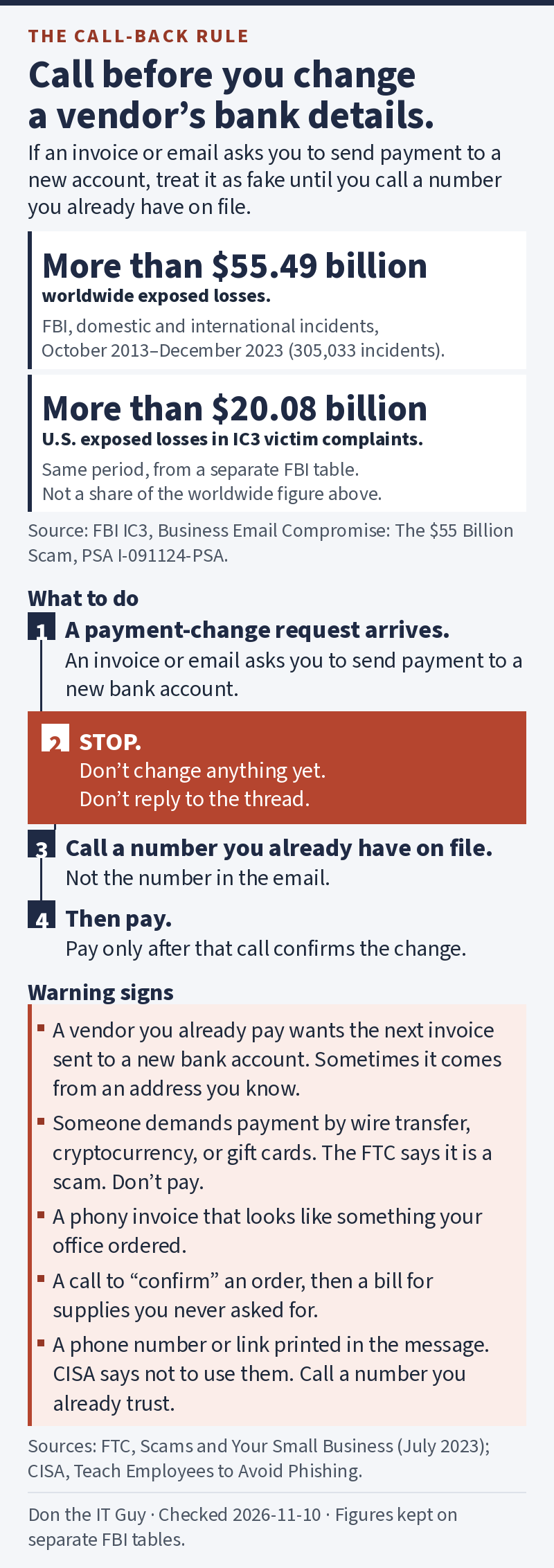
Call before you change a vendor’s bank details. Text description of the graphic
The email looks ordinary. A vendor you already pay wants the next invoice sent to a new bank account. Sometimes it comes from an address you know.
Don't change anything yet. Call them on a number you already have on file. Not the number in the email. Not a reply to the thread.
The FBI calls this business email compromise. Criminals get into a real business email account, then wait for a real payment and ask you to send it somewhere else. They target small local businesses as well as larger companies. From October 2013 through December 2023, the FBI reported 305,033 domestic and international incidents and more than $55.49 billion in exposed losses. In victim complaints to the FBI's Internet Crime Complaint Center over the same period, U.S. exposed losses were more than $20.08 billion. Global exposed losses rose 9% between December 2022 and December 2023.
There's another version that never mentions a new bank account. A phony invoice that looks like something your office ordered. Or a call to "confirm" an order, then a bill for supplies you never asked for. If someone demands payment by wire transfer, cryptocurrency, or gift cards, don't pay. The FTC says it's a scam. If merchandise arrives that you didn't order, don't pay for that either. The FTC says you have a legal right to keep it and use it for free.
Write the call-back rule down so nobody feels awkward following it. A second person can make the call. That's office policy, not a federal rule, but it slows the rush these emails depend on.
Check the full sender address, not just the display name, especially on a phone. The FBI also says to turn on full email extensions so a familiar name can't hide a lookalike address.
If a message feels off, CISA says not to click the link or use a phone number printed in it. Hover over the link to see where it actually goes. Then call a number you already trust. CISA, citing the FBI's 2024 Internet Crime Report, says phishing was the most reported cybercrime that year, with 193,407 complaints. Most online attacks begin with a single click.
If money already went out, call your bank the same day and ask for a recall. Then file a complaint at https://www.ic3.gov, whatever the amount. You can also report it to the FTC at https://reportfraud.ftc.gov.
Not sure an invoice email is real? I wrote a short checklist: how to tell if an invoice or payment-change email is fake.
What's the rule in your office when a vendor email asks for a new account?
A free weekly briefing, Tuesday mornings. About 2 minutes.
Get the briefing
About 2 minutes. The scam, breach, or tech change that could cost your business money.
No spam. Unsubscribe anytime. (Submitting opens Buttondown in a new tab.)
Don Zurbrick, Don the IT Guy
727-465-3607
Sign up, then reply to any Tuesday issue and tell me what the rule is in your office when a vendor email asks for a new account. I read every reply.
Sources
- FBI IC3: Business Email Compromise (checked 2026-11-10)
- FBI IC3: Business Email Compromise: The $55 Billion Scam, PSA I-091124-PSA (checked 2026-11-10)
- FTC: Scams and Your Small Business: A Guide for Business (July 2023) (checked 2026-11-10)
- CISA: Teach Employees to Avoid Phishing (checked 2026-11-10)
When a payment-change request arrives, stop. Do not change anything yet, and do not reply to the thread. Call the vendor on a number you already have on file, not the number in the email. Pay only after that call confirms the change.
Warning signs from the article: a request to send payment to a new bank account, even from an address you know; a demand for payment by wire transfer, cryptocurrency, or gift cards (the FTC says do not pay, it is a scam); a phony invoice that looks like something your office ordered; a call to “confirm” an order, then a bill for supplies you never asked for; and a phone number or link printed in the message, which CISA says not to use. Call a number you already trust.
FBI figures, October 2013 through December 2023, come from two separate tables and are not a share of each other. In domestic and international incidents, the FBI reported more than $55.49 billion in worldwide exposed losses and 305,033 incidents. In victim complaints to the FBI’s Internet Crime Complaint Center over the same period, U.S. exposed losses were more than $20.08 billion.
Sources: FBI IC3, Business Email Compromise; FBI IC3, Business Email Compromise: The $55 Billion Scam, PSA I-091124-PSA; FTC, Scams and Your Small Business (July 2023); CISA, Teach Employees to Avoid Phishing. Checked 2026-11-10.